Receipts and budget
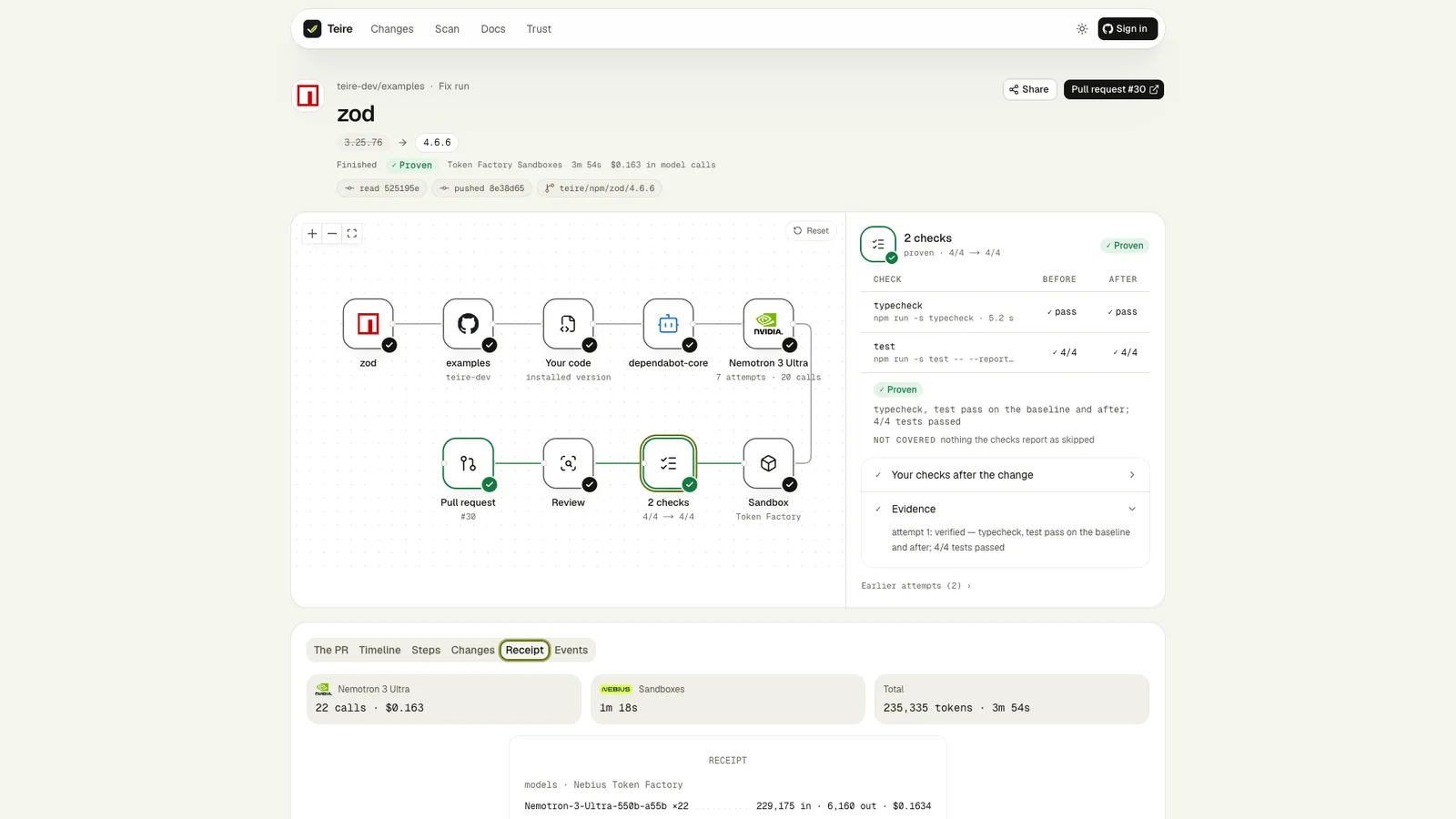
Every Nemotron call a scan or fix makes is recorded with its tokens, cost and latency, shown on the run and in the PR, and counted against a daily budget that pauses model work instead of overspending.
What is recorded
Each call becomes a row with the run, its purpose, the model, tokens in, cached and out, the cost and the latency:
| Purpose | When |
|---|---|
notes | Reading an upgrade's release notes |
fix | Each step of the agent |
review | The review of a passing fix, or of the dependency change when no code changed; and why a failed install failed |
triage | Tracing wrapped model IDs during a scan |
provider-page | Reading a discovered provider's pages |
Prices come from Token Factory's public models_info endpoint: per million input, cached input and output tokens. Cost is uncached input × input price, plus cached input × cached price, plus output × output price.
Where you see it
- The PR's Receipt section lists each step with its model, tokens and cost, then the sandbox time and the model total. A fix made by a plain swap says "deterministic fix, no model call" and costs $0.
- The run page's Receipt tab totals the calls per model and lists every sandbox command with its exit code and time.
- Settings in the dashboard adds up runs, tokens, model cost and sandbox time across your repositories.
- The trust page shows model spend today and this week, and the calls and cost per model.
The daily budget
Model spend over the last 24 hours is capped, by default at $10 (TEIRE_DAILY_COST_CAP_USD; 0 turns it off). When the cap is reached:
- fix runs wait with waiting for the model budget and retry every 30 minutes,
- scans skip page reading and triage and use what is already stored.
When Token Factory answers 402 for credits, every run waits with waiting for Token Factory credits. Every 15 minutes Teire sends a 16-token ping. When it gets an answer, work resumes on its own.
Both states are visible live on the trust page.
Nemotron on Token Factory
Every model call Teire makes goes to NVIDIA Nemotron on Nebius Token Factory. Ultra writes fixes and reads change pages, and Super takes over while Ultra is unavailable.
Evaluation
Twelve upgrades across six ecosystems, model retirements in all six languages and six clean repositories, each run end to end with Nemotron 3 Ultra and Nemotron 3 Super. Every fix was verified, with no false positives.